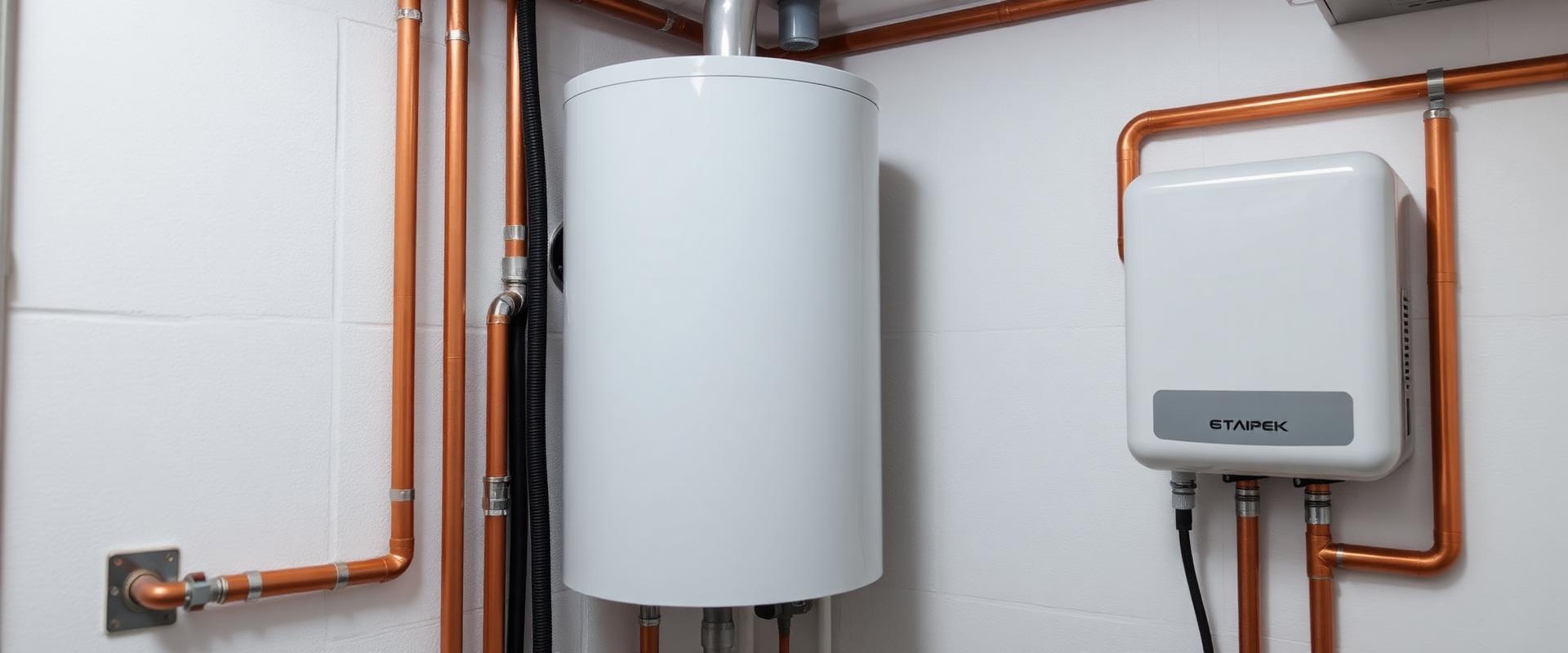
You typed "hot water heater vs hot water boiler" into a search bar, and you are probably standing next to a tank in the basement wondering which one you actually have and which one just quit on you. Here is the whole thing in one line before the details: a water heater only makes the hot water that comes out of your taps and showers, while a boiler heats your house through radiators or baseboard and, in some setups, makes your hot water too. They look similar sitting in a utility room. They do different jobs. Get the two straight and you will know which problem you have, which repair you need, and which of our teams to call. If your house is cold right now, or you just have no hot water, skip to the section that matches your symptom.
Hot water heater vs hot water boiler: the plain-language difference
A water heater does one job: it heats the potable water that runs to your faucets, showers, dishwasher, and washing machine. A boiler heats your home, sending hot water or steam out to radiators, baseboard fin-tube, or in-floor tubing, and in a combi or indirect setup it also handles your domestic hot water. That is the entire distinction. One is for washing. One is for warmth.
People call both "the hot water tank" because a standard water heater and a system boiler with a storage cylinder both store a reservoir of hot water in a similar-looking tank. The confusion is understandable. But a water heater cannot warm your house, and a heat-only boiler cannot fill your bathtub with domestic hot water on its own. When someone says "hot water boiler," they usually mean a hydronic boiler that runs hot water (not steam) through the heating system. That is the most common type on the Front Range.
Difference between a boiler and a water heater: how each one is built
The build is where the difference becomes obvious once you know what you are looking at. Here is what sets them apart under the jacket:
"Half the boiler-versus-water-heater confusion we untangle on service calls comes down to one thing: people expect the unit that heats the house to also be the one filling the tub. Sometimes it is. Often it is two separate appliances doing two separate jobs."
There is one wrinkle that makes the line blur. A boiler can be set up to make your domestic hot water in addition to heating the house, and that is where the two jobs overlap. More on that in the FAQ below, because it is the single most common follow-up question we get once the basic difference clicks.
Do I need a boiler or a water heater?
Start with what is broken, because the symptom tells you which appliance you are dealing with faster than anything else. If your faucets and showers run cold but the house is warm, that is a water heater problem. If the house is cold but your hot water still works, that points at the boiler or the heating side. If both are out at once, you likely have a boiler that handles both jobs, or two separate appliances that failed together, which is rare.
Here is the decision the way we frame it on-site for Denver Metro homes:
Two more local realities shape the choice, and they are the ones the national guides skip. First, gas appliances derate at altitude: a gas water heater or boiler delivers roughly 85 to 92 percent of its sea-level output at 5,280 feet, so sizing off a sea-level spec sheet leaves you short in a Denver winter. Second, converting to a tankless water heater or adding a combi boiler almost always means upsizing the gas line in a Denver-area home, because the on-demand burner draws more gas than the old tank did. We check the meter and the gas run before we quote either one, so there are no surprises after the unit is on the wall.
Not sure which appliance you are even looking at? Call (720) 880-8064 and describe the symptom. We will tell you whether it is a water heater or a boiler before we send anyone out.
When you do not need to replace anything yet
Since every result above this one is eager to sell you a new unit, here is the part they leave out: often you do not need a replacement at all, and we will tell you so. If your water heater is under about seven years old, holds temperature, and shows no rust or moisture at the base, a single failed part like a thermocouple or an element is a repair, not a reason to swap the tank. If your boiler is under about 15 years old, holds pressure, heats evenly, and got a professional service in the last 12 months, a single fault is a repair too. Do not let anyone talk you into replacing either appliance on age alone. Get a second opinion first, and check the simple stuff, a tripped breaker, a pilot out, a thermostat set wrong, before you assume the worst.
Think it is a repair, not a replacement? Talk to a licensed tech and get a flat-rate diagnosis. We diagnose first and quote the total before we pick up a wrench.
No heat but the water works, or hot water is out but the house is warm
Match your symptom to the appliance and you have your answer, and on the Front Range in winter the clock matters. Run this quick sort before you call so you can tell us exactly what is happening:
Once you know which appliance it is, you know which path to take. For heating faults and boiler work, we handle boiler repair, installation and replacement across the Denver metro, diagnosing the actual fault before we quote. For domestic hot water, we handle tank and tankless water heater replacement, permit and thermal expansion tank included in the flat rate. Either way, no hourly surprises. You know the number before we start.
Get the right fix for the right appliance
Deft Plumbing is licensed, bonded, and insured in Colorado, and we service both systems, tank and tankless water heaters and gas boilers, across the full Denver Metro along the Front Range. The advantage of calling one shop that does both is simple: we can tell you which appliance actually failed instead of selling you the one we happen to specialize in. We diagnose first, then quote flat-rate.
Call (720) 880-8064 or tell us what is going on and we will come back with a real number. Whether it turns out to be a water heater or a boiler, you will know the cost before we pick up a wrench. No hourly surprises.
Frequently asked questions
Can a boiler heat domestic hot water, not just the house?
Yes, and this is the overlap that causes most of the confusion. A boiler can make your domestic hot water in two ways. A combi boiler heats the house and produces hot water on demand from one unit, with no storage tank, so it doubles as your water heater. A system boiler pairs with a separate indirect cylinder, a storage tank the boiler keeps hot through a coil, so the same boiler feeds both the radiators and your taps. In either setup you do not need a standalone water heater at all, because the boiler covers both jobs. A heat-only boiler, by contrast, warms just the house and leaves the hot water to a separate water heater. On the Front Range, our 12 to 17 grain water means any tankless-style hot-water path off a combi benefits from a softener to protect the heat exchanger, and gas-line sizing gets checked before we install one. We size the recommendation to your house and your water, not to a brochure.
I have no heat but my hot water still works. Is it the boiler or the water heater?
The boiler, or the heating side of the system, almost certainly. If your hot water still runs fine to the taps, your water heater is doing its job, which means the appliance that heats the house is the one that failed. Check the thermostat is set to heat and above room temperature, confirm the boiler's service switch and breaker are on, and look at the boiler pressure gauge, which should read around 12 to 15 PSI cold. A gauge near zero means the loop lost pressure and the boiler will lock out rather than fire. If those check out and there is still no heat, the fault is internal to the boiler and it is a diagnose-first job. In a Front Range winter, do not wait on a no-heat call: a house that loses heat overnight can lose supply lines by morning through the same freeze-thaw cycling that bursts pipes here.
Is a "hot water boiler" the same as a hot water heater?
No, though the names make it easy to assume they are. A "hot water boiler" is a hydronic boiler that circulates hot water (not steam) through your radiators or baseboard to heat the house. A "hot water heater" makes the potable hot water for your taps and showers. The word "hot water" appears in both names, but one is a heating appliance and the other is a domestic-hot-water appliance. The only time they merge is a combi or indirect boiler that is built to do both jobs. If you are still unsure which one is sitting in your utility room, trace the pipes: a heating loop out to radiators means boiler, a single hot line out to your fixtures means water heater.