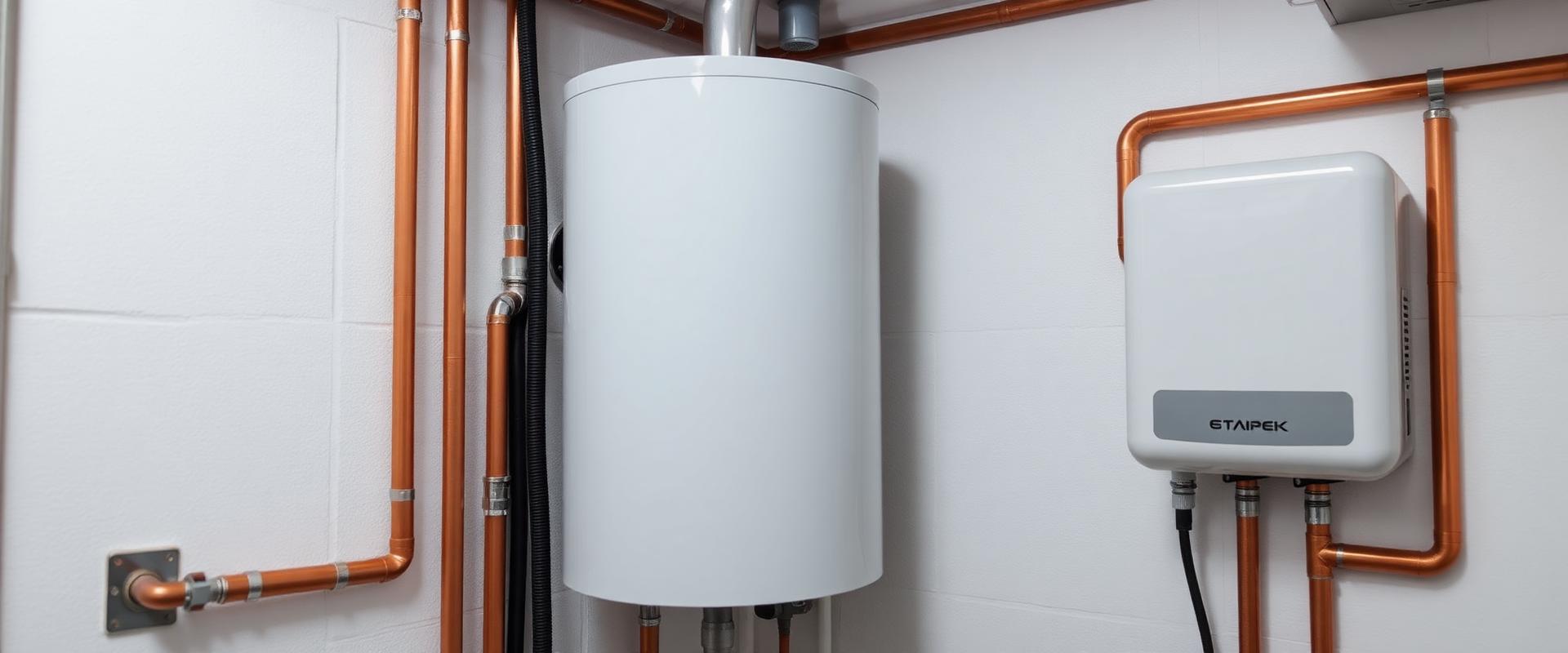
Water on the floor under your heater does not automatically mean the tank is done, and it does not automatically mean it is fine either. Here is the part most search results skip: on the Front Range, "leaking from the bottom" splits into two completely different situations. One is the inner tank rusted through, which no plumber can patch, and the other is a fitting, a valve, or condensation dripping down and pooling at the base while the tank itself is intact. Telling them apart before you call is the difference between a targeted repair and a full replacement. We will walk the diagnosis in the order we run it ourselves, tell you exactly when to shut off the water and the gas, and be straight about why a leaking tank is the one water heater problem you should not try to nurse along yourself.
Water heater leaking from the bottom: tank failure or fixable leak?
Water pooling under the base points at one of two very different faults, and the first job is to find where the water is actually coming from before you assume the worst. A rusted-through tank leaks from the tank body itself and cannot be repaired. A fitting, valve, or connection leak drips from a specific spot and runs down to the base, and most of those are fixable. Trace the water up to its source first:
The reason we chase the source before anything else is simple: the fix and the cost are nothing alike. A leaking drain valve is a part swap. A rusted-out tank is a new heater. Guessing wrong in either direction costs you money, which is exactly why we diagnose the leak before we quote a repair rather than sell you a tank on sight of a puddle.
The four fixable leaks that pool at the base
Most leaks that end up on the floor did not start at the floor. Water follows the outside of the tank down and collects at the lowest point, so a drip up top reads like a bottom leak. Here are the four we find most often, and all four are repairs, not replacements, as long as the tank body is sound.
1. T&P valve discharge. The temperature-and-pressure relief valve is the safety device on the side or top of the tank, with a discharge pipe running down toward the floor. If water is running out of that pipe, the valve is doing its job by relieving pressure, and the real problem is usually excess pressure, not the valve. 2. Drain valve drip. The drain valve at the base is often a cheap plastic unit that fails to seat after a flush or just weeps with age. A steady drip right at the spigot at the bottom is this, and it is a straightforward swap. 3. Cold or hot nipple sweat or a loose fitting. The threaded connections where the cold-in and hot-out lines meet the top of the tank can loosen or corrode and weep, and that water runs straight down the tank wall to the base. 4. Condensation, which is not a leak. A cold incoming supply on a high-demand day can sweat the outside of the tank and drip. If it dries up once the tank recovers and the room warms, you never had a leak.
T&P valve leaking on a water heater: the expansion-tank connection
A T&P valve that keeps discharging on the Front Range is very often an expansion-tank problem, and this is the detail that ties it back to how Denver plumbing is built. Most Denver Metro homes run a closed-loop system because there is a pressure-reducing valve on the main. On a closed loop, water cannot push back toward the street as it heats and expands, so the pressure climbs every heating cycle until the T&P valve opens to relieve it. Code requires a thermal expansion tank on a closed loop for exactly this reason.
> If your T&P valve drips only after the burner has run, and your home has a pressure-reducing valve on the main, look at the expansion tank before you blame the relief valve. A waterlogged or missing expansion tank is the usual cause here.
If that expansion tank is missing, waterlogged, or failed, the pressure has nowhere to go and the relief valve becomes the pressure release by default. When we replace a heater, that expansion tank is part of the flat-rate quote and it gets checked at the city inspection. It is not an add-on line item that surfaces later. If your T&P line is running and you are not sure why, call (720) 880-8064 and we will find the actual cause before quoting anything.
When the leak is the tank itself: why repair is off the table
Here is the honest line the results above us tend to soften. A leak from the tank body is the one water heater problem where a repair is not the answer, and being straight about that saves you from paying for a patch that fails. When the inner tank has rusted through, water is escaping through the steel wall of the tank. There is no fitting to tighten and no part to swap, because the failure is the vessel itself.
Once the tank is weeping through its wall, the clock is short and it only runs one direction. What starts as a damp spot becomes a puddle, then a steady flow, and the failure often accelerates once air hits the fresh corrosion. This is why we do not recommend babying a tank-body leak. A straight replacement with the permit pulled and the old unit hauled away is the cheaper math over the next few years than mopping a utility closet and waiting for it to let go on its own schedule, which on the Front Range is usually a weekend. We still assess age and condition first. We do not call for a replacement on age alone, but a rusted-through tank makes the call for us.
Is a leaking water heater an emergency? What to shut off, in order
A slow drip is not a 2 a.m. emergency, but a tank leak is a problem that only gets worse, and a fast leak on a gas heater is genuinely urgent. Regardless of speed, the shutoff sequence is the same, and doing it in the right order protects the tank and you:
1. Cut the heat source. On a gas heater, turn the gas control valve to "off" so the burner will not fire on a tank that is losing water. On an electric heater, shut off the breaker feeding it. A burner or element that runs on a draining tank self-destructs, so this comes first. 2. Shut the cold water supply. Close the cold inlet valve at the top of the tank to stop feeding the leak. If that valve is stuck or missing, shut off the main to the house. 3. Contain and drain if it is fast. For a real flow, hook a hose to the drain valve and run it to a floor drain or outside so the tank empties somewhere other than your floor. 4. Call once it is safe. With the water and heat off, the emergency is contained and you can get a real diagnosis instead of a panicked guess.
Deft Plumbing offers emergency response across the metro, and existing copy commits to 60 to 90 minutes during business hours on emergency calls. Ready when you are: (720) 880-8064.
Why a leaking tank is not a DIY job
We tell people to do their own work when the job is genuinely a homeowner repair. A leaking water heater is not one of those, and here is the reason that is not just us protecting a service call. A water heater replacement requires a permit in Front Range jurisdictions, and the swap has to pass a city inspection that checks the T&P discharge routing, the gas or electrical connection, the venting on a gas unit, and the required expansion tank. We pull the permit, schedule the inspection, and make it part of the flat-rate quote, so you are not coordinating with the city yourself on a heater that is already on the floor.
The other half of it is diagnosis. The whole point of this post is that a bottom leak is four or five different problems wearing the same puddle, and quoting a tank when it was a ten-dollar drain valve, or patching a valve when the tank has rusted through, both cost you. Tell us what you are seeing and we will trace it to the source before anyone talks price. You know the total before we pick up a wrench.
Frequently asked questions
Is a leaking water heater an emergency?
It depends on how fast it is leaking and what kind of heater you have. A slow drip from a fitting is not a middle-of-the-night emergency, but it is a problem that only gets worse, so it is worth addressing soon rather than waiting for it to become a flow. A fast leak, or any leak on a gas heater where the burner keeps firing on a draining tank, is urgent: shut off the heat source and the cold water supply right away, contain the water, and call. The reason a tank leak counts as time-sensitive is that inner-tank corrosion accelerates once it starts, so a damp spot today can be a flooded utility closet by the weekend. We offer emergency response across the metro, with existing copy committing to 60 to 90 minutes during business hours.
Water heater leaking from the bottom: can it be repaired?
It depends entirely on where the water is actually coming from, which is why the first step is tracing the leak to its source. If the water is dripping from the drain valve, the T&P discharge line, or a loose threaded connection up top and running down to the base, the tank is intact and the leak is almost always repairable as a part swap. If the water is weeping from the tank body itself, the inner tank has corroded through, and that cannot be repaired because the failure is the vessel, not a fitting. On Denver's 12-to-17-grain water, tank-body corrosion tends to show up around year 7 or 8, so the age of your heater is a strong clue. We diagnose the source before quoting, and we will not sell you a tank when a valve was the problem.
How long does a water heater last in hard water?
On the Front Range, plan on 7 to 10 years for a tank heater, not the 12 the label claims. Denver Metro supply runs 12 to 17 grains per gallon, and that mineral load does two things that shorten tank life: it scales the tank bottom, which makes the burner run longer and hotter, and it burns through the sacrificial anode rod faster, which lets the steel tank start corroding sooner. Once the anode is spent, the tank bottom is next, and a bottom leak follows. An annual flush and softer water both stretch that timeline, which is why on an early tank failure we treat softening as part of the replacement math rather than an upsell. Softer water is how you stop repeating the 7-to-10-year cycle.
Get a straight answer on the leak
Deft Plumbing is licensed, bonded, and insured in Colorado, and we serve the full Denver Metro along the Front Range, from Aurora and Lakewood to Arvada and Brighton. Whether the water under your heater is a drain valve you can swap, a T&P line pointing at a waterlogged expansion tank, or a rusted-through tank that has reached the end of its life on our hard water, the next step is the same: an honest diagnosis before anyone quotes a dollar.
Get the leak traced before anyone quotes a price
Call (720) 880-8064 or read how we handle a flat-rate water heater repair diagnosis across the metro. If the tank has corroded through past saving, we will point you to a straight hot water heater replacement, permit pulled and old unit hauled away, instead of charging you for a fix that fails next winter. You know the total before we touch anything. No hourly surprises.