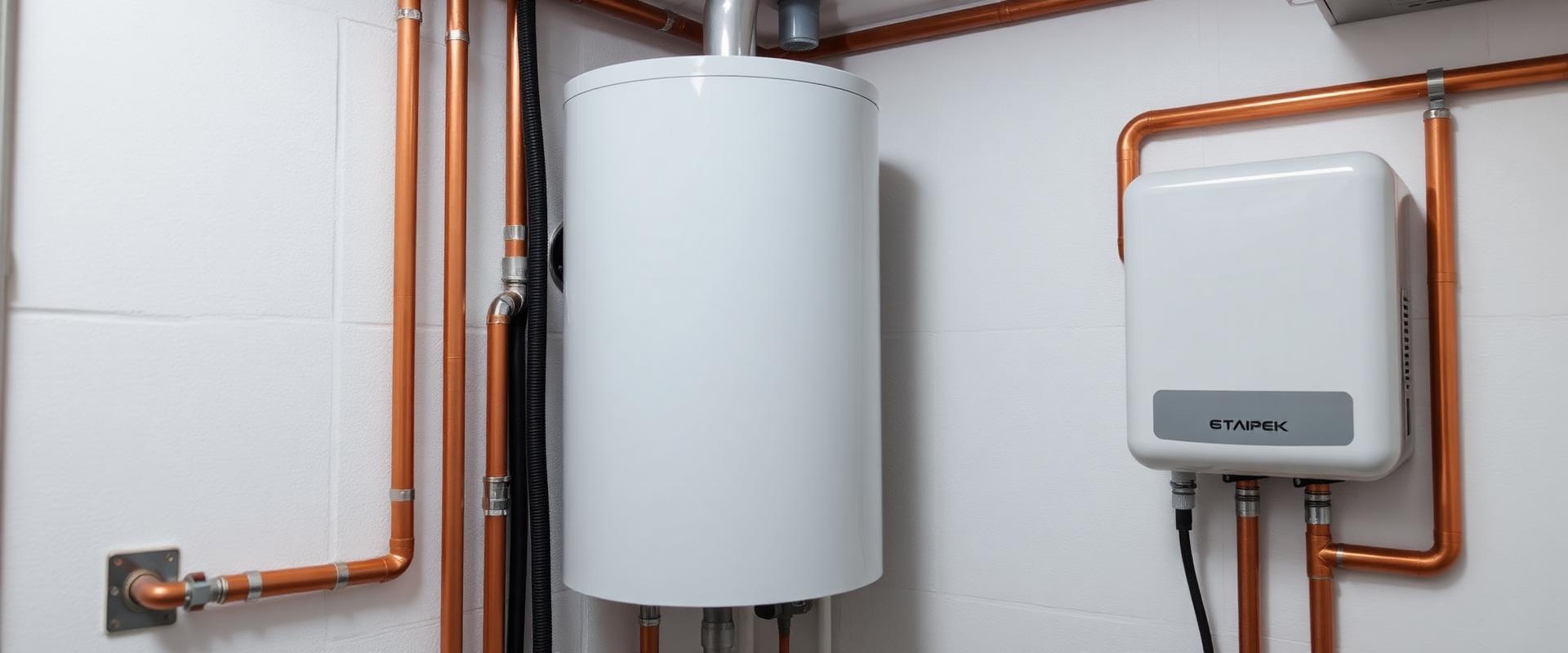
You searched a cost, so here is the cost up front, no scroll required: a standard 40- or 50-gallon natural gas tank water heater runs $1,200 to $2,400 installed in the Denver Metro, and that number already includes the unit, the permit, the code-required upgrades, and haul-away of the old one. Anybody who hands you a single firm price over the phone without seeing your utility closet is either padding for the unknowns or planning to add them to the invoice later. The honest version is a range, and the rest of this page is about what moves your job inside that range, why Front Range water pushes most homeowners into replacement years earlier than the box promised, and what the flat-rate number does and does not cover.
The fastest way to get your actual number is to tell us what's in your closet and get a flat-rate quote back. Or call (720) 880-8064 and describe the unit. Either way, you know the total before we touch anything.
Water heater replacement cost: what you'll actually pay in Denver
The published range for a like-for-like tank swap in the metro is $1,200 to $2,400, including permit, installation, the code-required expansion tank, new connectors, and haul-away. That is the number on our city pages and it holds for most homes where the existing gas line, venting, and access are already code-compliant. What moves you up or down inside it is rarely the brand of heater. It is what we find behind the access panel.
Here is what actually drives the price:
> Permit fees are set by the city and passed through at cost. We do not mark them up.
The point of a flat-rate quote is that the discoveries happen before you commit, not on the final bill. We look at the venting, the gas connection, and whether you are on a closed system, then hand you one number. For the full breakdown of code upgrades and the install sequence, see our flat-rate tank and tankless water heater installation page.
Why water heaters fail faster in Denver hard water
This is the part the national cost calculators skip, and it is the reason your replacement is happening sooner than you expected. Front Range water runs hard, generally in the 12 to 17 grains per gallon range across Jefferson County and much of Aurora. That mineral load deposits calcium scale on the bottom of a tank from the first week of operation. The scale insulates the burner, forces longer heating cycles, and quietly cooks the glass liner from the inside.
The manufacturer rates a tank for roughly 12 years. In our water, without annual flushing to clear sediment, tanks here realistically run 7 to 10 years. So if you are replacing a unit that died at year eight, it did not fail early by Denver standards. It failed right on schedule for Denver.
That has a direct cost consequence most people miss: if you drop a new tank into the same untreated water, you are buying yourself the same early failure on the same clock. This is why we treat a water softener as part of the math on an early-failure replacement rather than as an upsell. Softer water is how you stop repeating the eight-year cycle.
What the hard-water reality means for your spend
Not sure how old your current unit is or whether it is worth replacing now versus repairing? Call (720) 880-8064 and describe what it is doing. We will tell you straight whether it is a component repair or a vessel that is done.
Cost of a tankless water heater and installation
A tankless conversion costs more up front than a tank swap, and the reason is infrastructure, not the appliance itself. A condensing tankless unit fires on demand at 199,000 BTU or more at full draw. That much gas demand usually means two things your existing setup may not have:
1. A larger gas supply line. An undersized line is the single most common reason a new tankless unit underperforms in a Denver home. It is not a brand defect. The pipe simply cannot deliver the gas the unit wants. We verify your meter and line capacity before we order anything, and when the run needs to be upsized we handle that as gas line upsizing for tankless conversions, permit and pressure test included. 2. New stainless venting. Condensing tankless units need Category III or IV stainless venting, which is different from the double-wall flue a standard tank uses. That is parts and labor a tank swap does not require.
Add the Denver altitude factor on top: at 5,280 feet, gas appliances operate at roughly 85 to 92 percent of their sea-level BTU rating because there is less oxygen per combustion cycle. For a tankless unit near the top of its capacity range, that margin matters, so we spec the unit for Colorado conditions instead of national-average ratings.
> The upgrades a tankless conversion may require, larger gas line and new stainless venting, are exactly the line items a too-low phone quote leaves out.
What you get for the higher up-front cost is a longer service life and lower standby loss. A tankless unit descaled annually lasts roughly 18 to 20 years in our water, about twice what a tank delivers in the same conditions, and there is no reservoir staying hot around the clock whether you use it or not.
Tank vs. tankless water heater cost: which is right for your home
Neither one is automatically the right answer, and any plumber who defaults to one without asking about your household is selling a preference. The cost trade is straightforward once you frame it over the life of the unit instead of just the install day.
Tank: lower up-front, simpler install. A standard 40- or 50-gallon gas tank works with most existing gas lines and venting, installs in 2 to 3 hours, and sits at the bottom of that $1,200 to $2,400 range. The trade-offs are standby heat loss (the tank stays hot 24/7, about 15 to 20 percent of a typical home's water-heating energy) and a 7-to-10-year lifespan in our water.
Tankless: higher up-front, lower operating cost, longer life. Higher install cost driven by the gas and venting upgrades above, but 18 to 20 years of service, endless hot water at 9 to 11 gallons per minute, and no standby loss. The payback depends on how long you plan to stay in the home.
Here is the quick decision framework we actually use on-site:
We hand you both numbers, flat-rate, and you decide. We do not earn more from one answer than the other.
Frequently asked questions
Does a water heater replacement need a permit in Colorado?
Yes. Both Denver and Aurora, and effectively every metro jurisdiction, require a plumbing permit for a water heater replacement. It is not a technicality worth skipping. The permit triggers a city inspection of the T&P relief valve and drain line, the flue venting, the gas connection leak test, and the expansion tank on closed systems. We pull the permit, schedule the inspection, and handle any correction items as a standard part of every install. The permit fee is the only added cost and it is passed through at the city's fixed rate. It also protects you at resale and with your homeowner's insurance, since some carriers deny water-damage claims tied to unpermitted work.
Is a thermal expansion tank required?
On a closed-loop system, yes, and that is the standard setup in most Denver Metro homes. When there is a pressure-reducing valve on your main, water cannot push back toward the street as it heats and expands, so pressure builds inside the system. A thermal expansion tank absorbs that expansion and protects the heater, the relief valve, and your fixtures. Code requires it on closed loops, an inspector will check for it, and a quote that leaves it out is a quote that is going to fail inspection. It is already included in our flat-rate price.
What is included in a flat-rate water heater quote?
Everything needed to leave you with a working, code-compliant, inspected install. That means the unit, all parts and labor, new stainless-braided supply lines, a properly rated T&P relief valve, the thermal expansion tank on closed systems, the city permit at cost, inspection coordination, and haul-away of the old unit. No separate line items appear on the invoice that were not in the quote. The whole reason we quote a flat rate after seeing the job is so the discoveries happen before you commit, not after the old unit is already disconnected.
Get your actual number
Deft Plumbing is licensed, bonded, and insured in Colorado, and we serve the full Denver Metro including Aurora, Lakewood, Arvada, and Brighton. Whether you are leaning tank or tankless, the next step is the same: a real number for your home instead of a range from the internet.
Get a flat-rate water heater quote and tell us what is in your closet, or call (720) 880-8064 to talk it through with a licensed tech. You know the total before we pick up a wrench. No hourly surprises.